

Greece produces some of the most distinctive olives in the world, and the differences between varieties matter far more than most guides suggest. Kalamata olives are not interchangeable with Halkidiki, and neither is a substitute for Amfissa or Throuba. Each variety has its own curing method, texture, fat profile, and the right place on the table. This guide covers the main Greek olive varieties, explains what makes each one different, and gives you practical guidance on how to use them.
Whether you are building a meze table, looking for a reliable everyday olive for cooking, or simply trying to understand what you ate at a taverna in Nafplio, this is the reference you need.
Why Greek olives are worth knowing by variety
Greece is consistently among the top three olive-producing countries in the world, but what makes Greek olives distinctive is not volume — it is variety and curing method. Some Greek olive varieties carry PDO (Protected Designation of Origin) certification, which ties production to a defined geographic area and traditional methods. Others are grown and cured with equal care across broader regions, without PDO status, and reach the same quality level. The certification tells you about origin and traceability; it does not tell you the whole story about flavour or craftsmanship.
The variety of the olive determines the fruit's size, flesh-to-pit ratio, polyphenol content, and the flavour compounds that develop during curing. The curing method — brine, dry salt, natural fermentation, or lye — then amplifies or softens these characteristics. Understanding both gives you the ability to choose deliberately, not by chance.
From a nutritional standpoint, olives are one of the most nutritionally consistent snacks in the Mediterranean diet. They are rich in monounsaturated oleic acid and contain a range of polyphenols associated with anti-inflammatory properties in long-term dietary research. A small portion of olives provides satisfying, stable energy without the blood sugar volatility of most processed snacks. This is precisely why they appear at every Greek table as a first course, not an afterthought.
The main Greek olive varieties
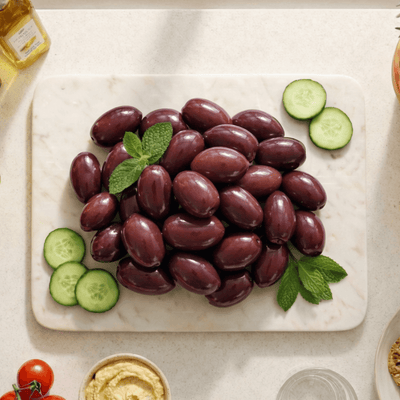
Kalamata
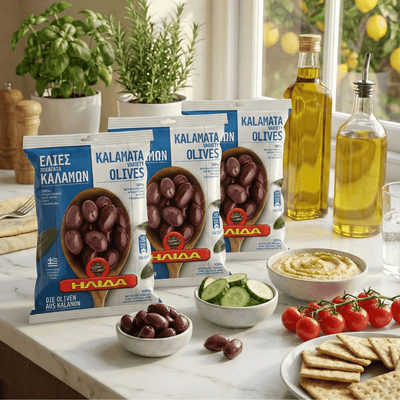
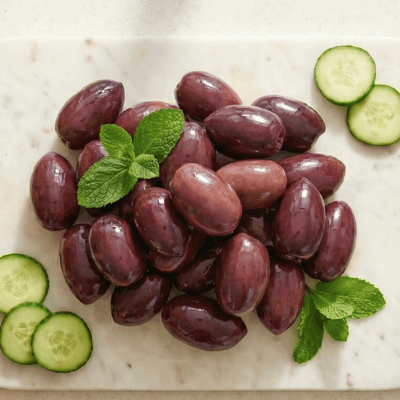
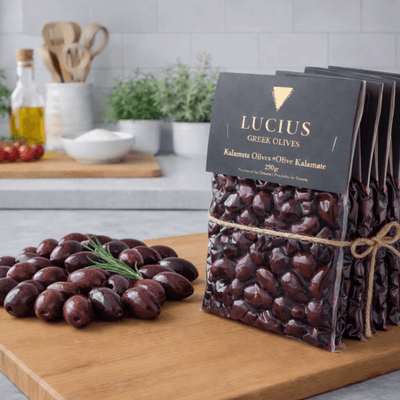
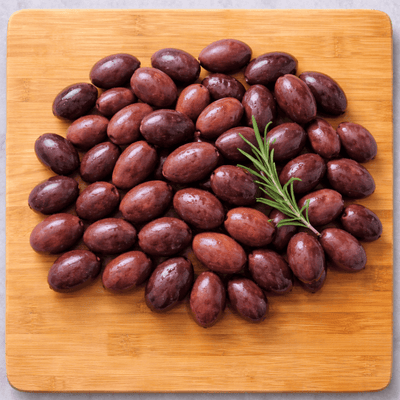
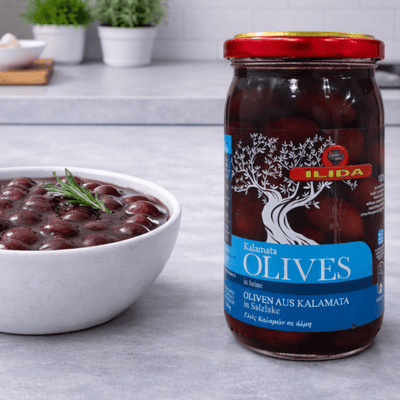
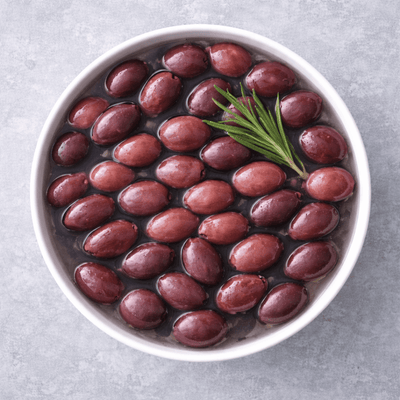
The most internationally recognised Greek olive is grown primarily in the Peloponnese region. Kalamata olives are almond-shaped, deep purple to near-black in colour, and cured in red wine vinegar and salt brine, which gives them their characteristic sharp, slightly tannic, and fruity flavour. The flesh is firm but yielding, and the pit separates cleanly. They are not cooked in brine to soften them — they ferment naturally, which preserves the complexity of the fruit.
The Kalamata cultivar is grown across several areas of southern Greece. A smaller portion of production carries PDO certification, which requires the olives to come from a tightly defined zone within Messinia and meet specific processing standards. Beyond that zone, producers working with the same cultivar and traditional curing methods can deliver equally expressive results — what matters most in a Kalamata olive is the quality of the fruit at harvest and the curing time, not the certification alone.
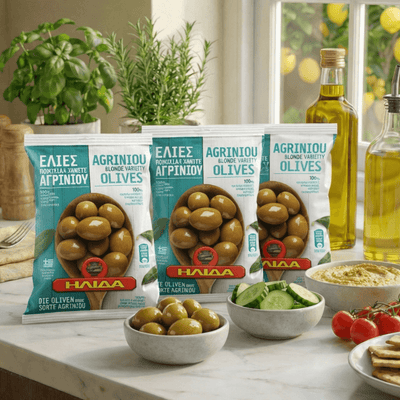
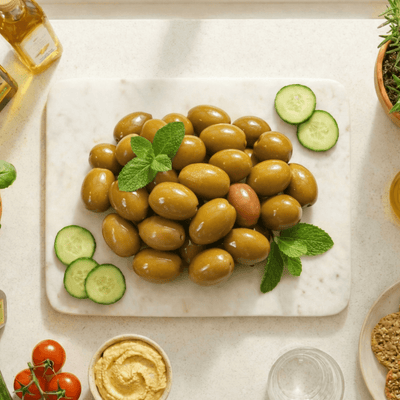
Halkidiki
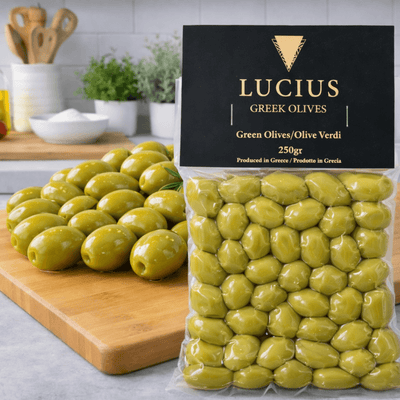
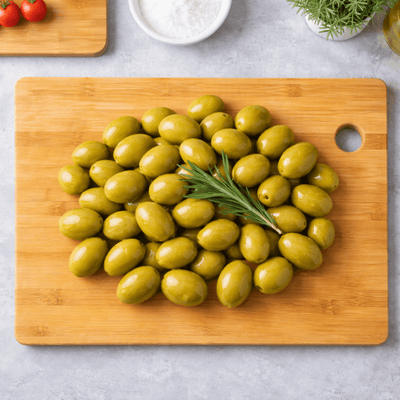
A large, green, meaty olive from the Halkidiki peninsula in northern Greece. The Halkidiki cultivar produces one of the biggest olives in Greek production, with a high flesh-to-pit ratio that makes it suitable for stuffing. Green olives are harvested before full ripening, which means they retain higher polyphenol content than darker, riper varieties. The bitterness of the fresh olive is reduced through lye treatment or natural brine fermentation, leaving a clean, mild, slightly buttery flavour with a firm bite.
Halkidiki olives are commonly found plain, stuffed with red pepper or almonds, or marinated in herbs. Their mild flavour makes them versatile at the table and a natural pair for Greek cheese.
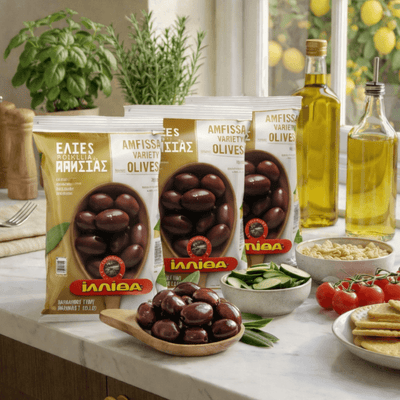
Amfissa
Produced in the area around Delphi in central Greece, the Amfissa olive is harvested at a later stage of ripeness than Kalamata or Halkidiki, which gives it a softer texture and a rounder, earthier flavour. Amfissa olives are typically black to dark brown in colour and cured in dry salt or brine without additives. The result is a mild, meaty olive with lower acidity — gentler than Kalamata, without the vegetal firmness of Halkidiki.
Amfissa olives are less common outside Greece but appear regularly in quality delis and specialty Greek food stores. They are particularly well-suited to bread, grilled vegetables, and simple mezedes that do not need a sharp acidic counterpoint.
Throuba Thasou
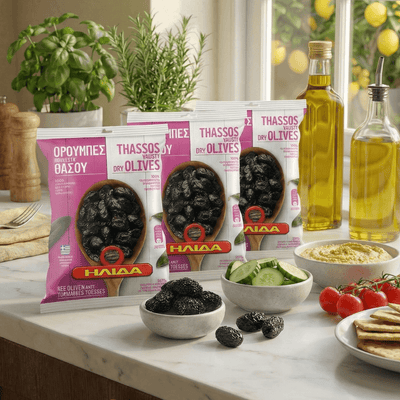
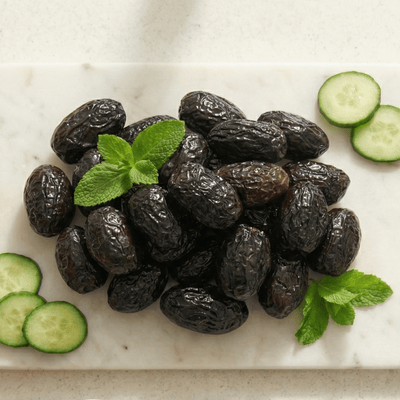
One of the most unusual olives in Greek production, Throuba from the island of Thasos, is a naturally wrinkled black olive remarkable for one specific reason: it ripens fully on the tree and undergoes no brine curing. The olive naturally loses most of its bitterness on the branch through enzymatic action, and is then dried in salt after harvest. The result is a wrinkled, concentrated, intensely flavoured olive with low moisture and a rich, almost winey depth.
Throuba Thasou has a short shelf life compared to brine-cured olives and is less widely distributed, but its flavour is distinctive enough that it merits seeking out. It is typically eaten as a table olive rather than used in cooking, and it pairs well with aged hard cheeses and full-bodied red wine.
Konservolia
The Konservolia cultivar is the most widely grown olive in Greece by volume and accounts for a significant portion of table olive exports. It is grown across several regions, with notable production in Fthiotida, Arta, and Stylida. Konservolia olives range from green to black depending on harvest timing and are characterised by their large size and high oil content. They are typically cured in brine and deliver a balanced, mild flavour without strong acidic or bitter notes.
Many commercially available Greek table olives labelled by size or colour rather than variety are Konservolia. They represent solid everyday quality and are the olives most likely to appear in bulk at a Greek market stall.
Greek olive varieties at a glance
| Variety | Colour | Flavour profile | Best use |
|---|---|---|---|
| Kalamata | Deep purple to black | Sharp, fruity, slightly tannic | Meze, salads, snacking |
| Halkidiki | Green | Mild, buttery, firm | Snacking, stuffed cheese boards |
| Amfissa | Black to dark brown | Mild, earthy, low acidity | Bread, grilled vegetables, simple meze |
| Throuba Thasou | Black, wrinkled | Concentrated, winey, no bitterness | Table olive, aged cheese, wine pairing |
| Konservolia | Green to black | Balanced, mild, clean | Everyday table olive, bulk use |
How to serve Greek olives
As a standalone meze
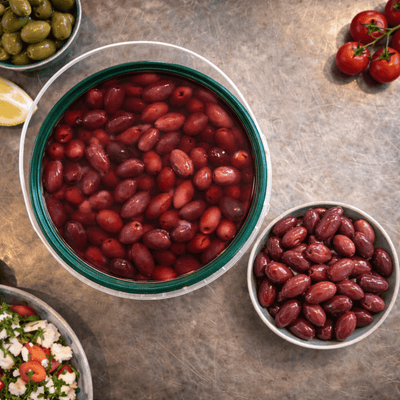
In Greece, olives are rarely dressed up. A small bowl of good Kalamata olives with a drizzle of olive oil and a few dried oregano leaves is a complete meze on its own. The quality of the olive is expected to carry the dish. This is the most direct way to evaluate what you have: plain, at room temperature, with bread. If the olive needs elaborate accompaniment to taste good, it is not a good olive.
On a meze board
When building a Greek meze selection for a table, olives play the role of a palate anchor — they provide bitterness, salt, and fat that balance the milder flavours of cheese, dips, and bread. A combination of at least two varieties works better than a single variety: the contrast between a sharp Kalamata and a mild Halkidiki gives the board range without requiring more preparation. For a larger table, adding Amfissa provides a third texture and flavour register.
You can find a full range of Greek olives, including Kalamata, Halkidiki, and Amfissa varieties, in the Greek olives collection.
As an everyday snack
Olives are one of the few genuinely satisfying snacks that require no preparation and deliver consistent nutritional value. A small portion — around 30 to 40 grams — provides oleic acid, polyphenols, and enough fat and flavour to curb appetite effectively between meals. This is the snacking format that the Mediterranean diet has relied on for centuries, and the reason olives appear on tables before the meal even begins. Halkidiki olives work particularly well in this context because of their mild flavour and firm, satisfying texture.
In cooking
Greek olives can be used in cooked preparations, though their strongest contribution is usually as a finishing ingredient rather than a base. Adding Kalamata olives to a lamb stew or a slow-cooked chicken dish in the final 10–15 minutes introduces a savoury depth that develops without the olive becoming bitter. Amfissa olives hold their texture better during cooking and are well-suited to bread doughs, focaccia-style preparations, or roasted vegetable dishes. Halkidiki olives are less commonly used in cooking because their relatively mild profile does not intensify as distinctly under heat.
Storing Greek olives at home
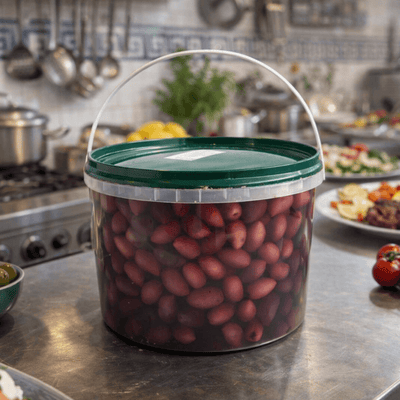
Brine-cured olives — Kalamata, Halkidiki, Amfissa, Konservolia — should be kept in their brine once opened and refrigerated. Removing them from the brine accelerates desiccation and flavour loss. If you transfer them to a new container, cover them fully with brine or a light olive oil. Properly stored, opened brine olives keep for two to three weeks in the refrigerator without quality loss.
Dry-cured olives such as Throuba Thasou have lower moisture content and are more stable at room temperature before opening, but once the packaging is open, they benefit from refrigeration and should be consumed within two weeks. Do not submerge dry-cured olives in brine after opening — this changes their texture and dilutes their flavour.
For olives purchased vacuum-sealed or in a jar, always check the producer's guidance. Greek olives in sealed packaging typically have a shelf life of 12 to 24 months unopened, but the flavour is at its best in the first six months after production.
Building a Greek summer table around olives
The Greek summer table does not need to be elaborate to work. Olives, a good pita, a few mezedes, and a piece of feta: that combination covers all the flavour registers — salt, fat, acid, texture — and requires nothing more than opening jars and arranging a board. It is the format that appears at every Greek summer gathering, from a kitchen table in Athens to a terrace in the Cyclades, and it works precisely because it relies on the quality of individual ingredients rather than on technique.
For everything you need to build that table — olives, meze, pita, and pantry staples shipped directly from Greece — the Greek Summer collection is the most practical starting point.
For the full picture on how to structure a Greek dinner or meze evening at home, see the pillar article How to Host a Greek Dinner at Home.
Frequently asked questions about Greek olives
What is the difference between Kalamata and Halkidiki olives?
Kalamata olives are a dark, almond-shaped variety grown primarily in the Peloponnese, cured in red wine vinegar brine, with a sharp, fruity, and slightly tannic flavour. Halkidiki olives are large, green, and harvested before full ripening, giving them a milder, firmer, and more buttery flavour. They are typically cured in salt brine and are often stuffed. The two varieties are not interchangeable: Kalamata works well as a sharp flavour contrast on a meze board, while Halkidiki is better as a standalone snack or paired with mild cheese.
Does PDO certification mean better quality?
Not necessarily. PDO (Protected Designation of Origin) certification means the product comes from a defined geographic area and follows specified traditional methods. For Kalamata olives, the certified zone covers a specific part of Messinia in the Peloponnese — a small area relative to the full extent of Kalamata cultivation in Greece. Many producers working outside that zone with the same cultivar and the same traditional curing methods deliver olives of equal or comparable quality. PDO is a guarantee of origin and traceability, which is genuinely valuable. It is not, on its own, a guarantee of superior flavour or craftsmanship.
Are olives a healthy snack?
Yes, in the context of a balanced diet. Olives are rich in monounsaturated oleic acid, the same fatty acid present in extra virgin olive oil, and contain polyphenol compounds that have been associated with anti-inflammatory properties in Mediterranean diet research. A small portion of 30 to 40 grams provides satisfying fat and flavour without refined sugar or significant processed additives. This is why olives have historically served as a pre-meal snack in Mediterranean food culture, not as a condiment.
What is a Throuba olive, and why is it different?
Throuba Thasou is an olive from the island of Thasos in northern Greece. It is unusual because it ripens completely on the tree and undergoes no brine curing — the natural enzymatic process on the branch reduces bitterness, and the olive is then simply dried in salt. The result is a wrinkled, concentrated, intensely flavoured black olive with no artificial additives and a short shelf life. Its flavour profile is closer to dried fruit than to a typical brine olive, which makes it a distinctive choice for a cheese board or a glass of wine.
How many olives make a portion?
A standard portion of table olives is generally considered to be around 30 to 40 grams, which corresponds to approximately seven to ten medium olives depending on variety and size. At this quantity, olives provide a meaningful contribution of healthy fats and flavour without excessive sodium intake from the brine. As a meze component, a portion of this size per person is sufficient as part of a wider spread; as a standalone snack, slightly more is typical.



2 comments
Comment puis je faire pour avoir tous les textes en français.
Cordialement ,
Merci pour votre réponse
Sono ghiotto di olive verdi.
La varietà Halkidiki si presta ad essere privata del nocciolo per imbottire in panino croccante tagliato a metà.
Semplice da deliziosa merenda.