Skip to content



Liofyto
Liofyto Extra Virgin Olive Oil – Green-Harvested, from Arcadia (1L)
Liofyto Extra Virgin Olive Oil – Green-Harvested, from Arcadia (1L)100 in stock
Couldn't load pickup availability


 🌿 ECO DELIVERY — Tracked shipping across Europe · These products travel by ground courier, carefully packed for the journey from Greece. · 💶 Flat rate: €8.90 across Europe · 🎁 Free shipping on orders over €139 · ⏱️ Delivery in 3–5 working days from dispatch · 📦 Order preparation: 2–4 working days · 🤝 Our promise: if your order arrives damaged or not as described, contact us — we will find the right solution. · 👉 Full shipping details →
-
 Peloponnese
-
 Vegan
Vegan
Product Description
Product Description
Greek Olive Oil for Every Day, in a One-Litre Bottle
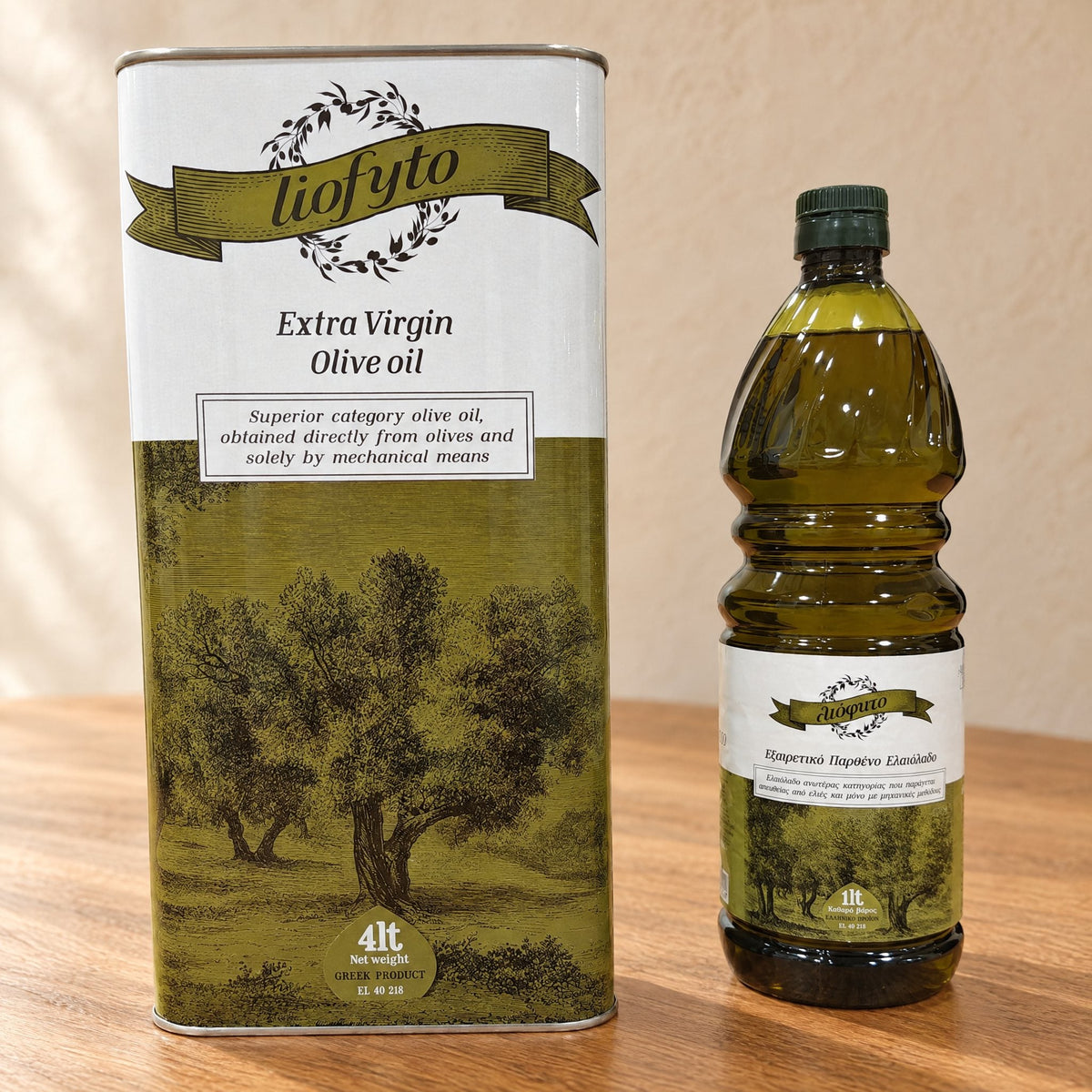
Liofyto Extra Virgin Olive Oil is pressed from olives grown in selected areas of Laconia, Messinia and Ilia, and produced in Doliana, in the mountains of Arcadia, by a family firm that has worked in olive oil for decades. The olives are picked while they are still green and milled within a few hours of harvest. It is the same oil as our four-litre Liofyto tin, in the size you reach for every day.
Green olives give less oil than ripe ones, and they give a different oil: fruity, with a clean bitterness and a peppery catch at the back of the throat. Both are normal. They come from phenolic compounds naturally present in the olive fruit, they are most pronounced when the olives are picked before they ripen, and they fade a few seconds after tasting. In olive oil assessment, bitterness is never counted as a defect: a faulty oil tastes musty, winey or rancid instead. The producer's own panel assessment records fruitiness above zero and zero defects.
A household that cooks Mediterranean most days goes through roughly a litre a month: the dressing on the evening salad, a spoonful over beans or lentils, the oil in a tray of roasted vegetables. The bottle weighs little and does not break in transit, so it travels well. It is not a tin, though, and it lets some light through: keep it in a cupboard, not on the worktop. If you already know you will use it every day, the four-litre tin holds the same oil and costs less per litre.
How to use it
- Everyday dressing on salads, pulses, tomatoes and toasted bread, used raw, where the green character shows most.
- Roasting vegetables, where the oil has to carry the heat and still taste of something.
- Slow-cooked dishes in the Greek ladera tradition, where the oil is part of the dish, not just a cooking medium.
- Finishing soups, grilled fish and pulses, off the heat.
Nutritional Components
Nutritional Components
What extra virgin olive oil is made of
Olive oil is a single-ingredient food, so its profile is entirely a question of which fats it contains and how carefully the fruit was handled. The producer declares the full breakdown and the analytical parameters on the label, which is not a given in this category.
The fat breakdown, as declared
- Monounsaturated fat: 70.7 g per 100 ml, out of 91.6 g of total fat. Monounsaturates are the dominant fraction of olive oil and the reason it behaves the way it does in the pan.
- Saturated fat: 13.6 g per 100 ml.
- Polyunsaturated fat: 7.3 g per 100 ml.
- A single ingredient: extra virgin olive oil. The full values are in the table below.
The analytical parameters are declared on the label.
- Acidity: 0.8% or below. This is the legal ceiling for extra virgin olive oil. An oil above it cannot be called extra virgin.
- Peroxide value: 20 meqO2/kg or below. A measure of oxidation.
- Organoleptic assessment: fruitiness above zero, defects zero. The panel test every extra virgin olive oil has to pass.
- Waxes: 150 mg/kg or below. K232: 2.50 or below. K270: 0.22 or below. ΔK: 0.01 or below. Spectrophotometric parameters used to confirm the oil has not been refined or blended.
Where the bitterness comes from
The bitter note and the peppery catch are caused by phenolic compounds naturally present in the olive fruit, and they are most pronounced when the olives are harvested before they ripen, as these are. They fade within seconds of tasting and are not a defect.
Nutritional values per 100 ml
- Energy: 3,389 kJ / 824 kcal
- Fat: 91.6 g of which saturates: 13.6 g, monounsaturates: 70.7 g, polyunsaturates: 7.3 g
- Carbohydrates: 0.0 g of which sugars: 0.0 g
- Fibre: 0.0 g
- Protein: 0.0 g
- Salt: 0.0 g
Ingredients
Extra virgin olive oil.
Net content: 1 litre. Greek product.
Useful Information
Useful Information
Storage guide: how to keep a one-litre bottle at its best
Olive oil has three enemies, in this order: light, heat and air. A tin keeps light out on its own; a bottle needs a cupboard to do the same job. The other two are up to where you put it and how you close it.
How to store it correctly
- Away from light and heat: a cupboard, a pantry, the coolest corner of the kitchen. The producer's reference condition is a dry, dark place at around 18°C. Not on the worktop next to the hob, which is the most common mistake.
- Closed firmly after every use: each opening lets air in, and air ages an oil faster than time does.
- Behind a door, not on display: the bottle lets some light through, so it belongs inside a cupboard rather than on an open shelf.
- Never refrigerate: olive oil turns cloudy below roughly 7°C. It is harmless and reverses at room temperature, but there is no reason to cause it.
Freshness timeline
- Unopened, stored as above: 16 months declared by the producer. The best-before date and the lot number are printed on the upper part of the label.
- Opened, kept closed and in the dark: a one-litre bottle is normally finished in about a month by a household that cooks, well inside its declared life.
Product details
- Format: plastic bottle, net content 1 litre
- Olives from: selected areas of Laconia, Messinia and Ilia, Peloponnese, Greece
- Produced and packed by: Foufas Bros S.A., Doliana, Arcadia
- Harvest: olives picked while still green, milled within a few hours
- Category: extra virgin olive oil, obtained directly from olives by mechanical means alone
- Declared acidity: 0.8% or below
- Sensory profile: markedly fruity, moderate bitterness, moderate pungency
- Allergens: none
- Ingredients: extra virgin olive oil
Bottle or tin?
The one-litre bottle and the four-litre tin hold the same Liofyto oil. The bottle weighs little, does not break and pours easily, which makes it the practical size for a first order or a smaller kitchen. The tin keeps light out completely and costs less per litre, which makes it the better choice once you know how fast you use it. Same olives, same producer: each kitchen chooses its size.
Share