❄️ FRESH DELIVERY — Shipped from Greece, arrives fresh · These products travel by express air freight in insulated packaging to protect freshness from our warehouse to your door. · 🗓️ We ship Monday, Tuesday and Wednesday only — this protects your order over the weekend. · ⏱️ Delivery in 24–48 hours from dispatch · 📦 Order preparation: 2–4 working days · 🤝 Our promise: if your order arrives damaged or not as described, contact us — we will find the right solution. · 👉 How FRESH shipping works →
Product Description
The winter dish of Greek home kitchens: cabbage, rice and avgolemono
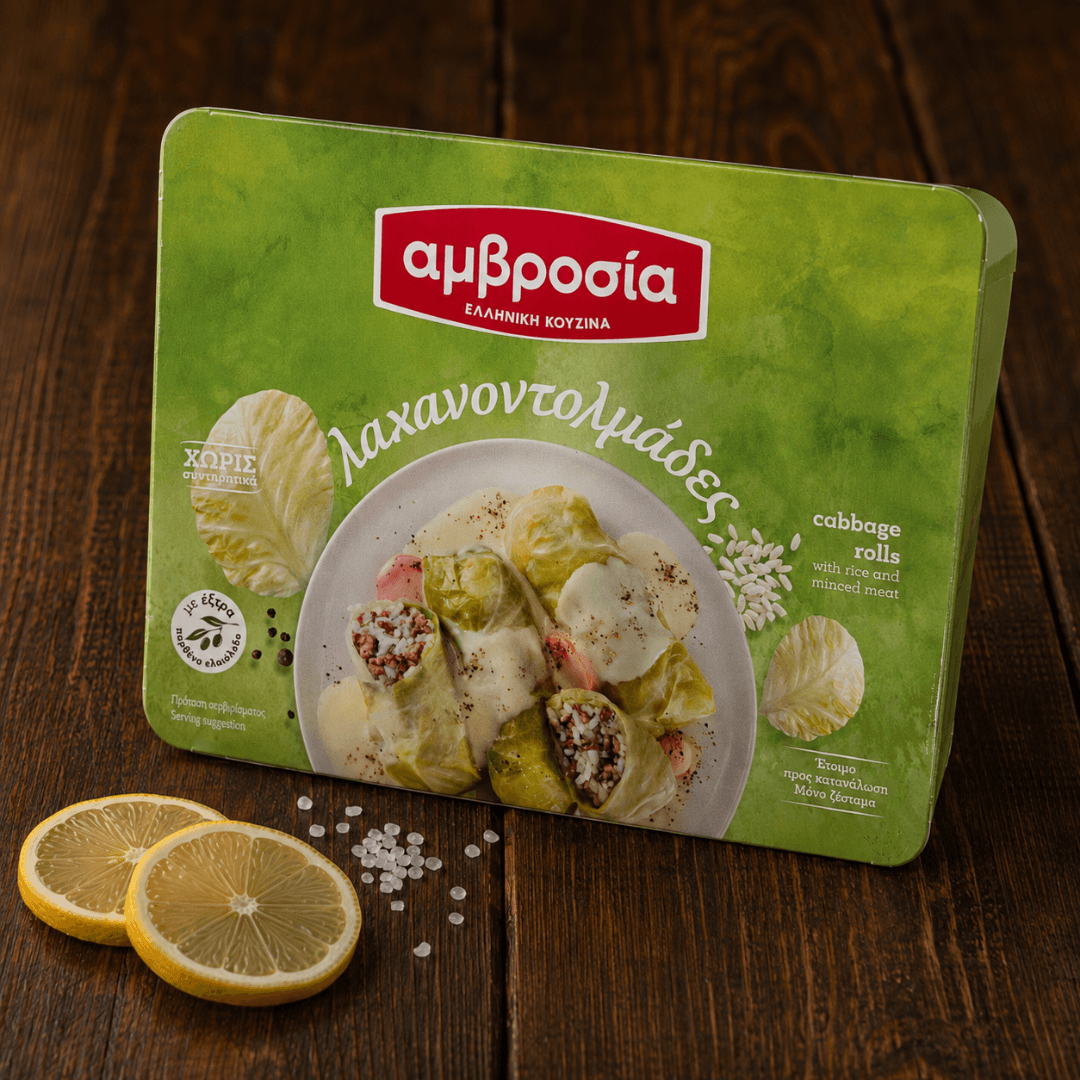
Lahanodolmades are what a Greek kitchen makes when cabbage is at its best: leaves blanched until they fold without tearing, rolled around rice and minced meat with carrot, onion, and herbs, then simmered and finished with avgolemono, the egg and lemon sauce that thickens a dish without any cream in it. Amvrosia makes them in Thessaloniki and chills the tray rather than freezing it. Cabbage is by far the largest ingredient at 47%, with 12% boiled rice and 10% minced beef and pork of EU origin in the filling, and 1,2% extra virgin olive oil. What arrives is one sealed 400g tray that has never been through a freezer.
The sauce is what separates this from the cabbage rolls of central and eastern Europe. There is no tomato and no cream here: egg yolk and concentrated lemon juice are worked into the cooking liquid until it turns pale and just thick enough to coat, sharp rather than rich, with dill, mint and parsley underneath. The leaves stay tender without going slack, and a roll cut in half holds its section instead of spilling. This is also precisely what freezing ruins, because an egg and lemon sauce splits as it thaws and cabbage leaves lose their structure. Chilled, neither happens.
One thing is worth knowing before you order, because it sets the expectation right. A full tray carries 336 kcal, 8,8g of fibre and 14g of protein, with cabbage making up almost half of the tray. That is a complete lunch on its own, and a main course at dinner alongside bread, a piece of feta or a salad, which is how it is eaten in Greece. It is not a dense oven bake, and it is not trying to be one.
No preservatives, and chilled rather than frozen: how that works
Fresh food ordered online always raises the same question, which is how it keeps without either a freezer or a preservative. The answer here is the packaging. The tray is sealed in a protective atmosphere, and that is what keeps the dish without anything being added to it.
No preservatives in the recipe. The ingredient list is the whole story.
Keep refrigerated below +7°C, and once opened, eat within 24 hours.
Never frozen at any point, which is why the avgolemono stays smooth, and the leaves keep their bite. The use-by date is printed on the tray.
How to use it
Oven, 180°C for 13 to 15 minutes once preheated. Pierce the film in two spots first; remove it before serving.
Microwave, 3 to 4 minutes at 800W, same piercing step. Keep the tray clear of the oven element and the grill.
A full lunch on its own, or an evening main with bread and a piece of feta to round it out.
Half a tray as a warm starter before grilled fish or meat, with the sauce spooned over.
Nutritional Components
Cabbage, rice and avgolemono: what is actually in this tray
Lahanodolmades are built the other way round from the rest of this range. Where a moussaka or a pastitsio is starch and meat with vegetables inside, this is a vegetable dish with rice and meat inside: 47% cabbage, 12% boiled rice, 10% minced beef and pork of EU origin, and a sauce made of egg yolk and lemon rather than milk or tomato. The nutritional profile follows directly from that, and it is the reason this tray reads differently from the others on every line.
What the numbers mean in practice
336 kcal in a full 400g tray: 84 kcal per 100g, with cabbage making up 47% of the recipe. A complete lunch, not a half one.
8,8g of fibre per tray: 2,2g per 100g, almost entirely from the cabbage and the carrot.
14g of protein per tray: 3,5g per 100g, from the minced meat, the rice and the egg in the sauce. Protein supplies 16,7% of the energy in this dish.
No preservatives: the tray holds because it is sealed in a protective atmosphere, not because anything was added to the recipe.
Salt 1,10g per 100g, which is 4,4g in a full tray, about three quarters of the 6g daily reference intake for an adult. Worth knowing if you are watching sodium: this is a seasoned, slowly simmered dish, not a low-salt product.
Contains wheat (gluten) and egg. May contain traces of milk, mustard, celery, soybeans, sesame seeds, fish, shrimps and crabs.
Produced and packed by Amvrosia SA, Sindos Industrial Zone NB6, Thessaloniki. All figures are taken from the printed label on the tray, which prevails over any other source.
Useful Information
Storage guide: below +7°C, and what the sealed tray does
This is a fresh, chilled dish, not an ambient or frozen one, and everything about how it keeps follows from that. It travels cold, it lives in the fridge, and the sealed film is what protects it until you open it.
How to store it correctly
Keep refrigerated below +7°C: put it in the fridge as soon as it arrives, in the coldest part rather than the door.
Do not freeze it: an egg and lemon sauce splits when it thaws, and cabbage leaves lose their structure. This is the dish in the range that freezing damages most.
Leave the film sealed: the protective atmosphere inside the tray is doing the preservation work, and once the seal is broken, that protection ends.
Freshness timeline
Unopened, refrigerated: keeps until the use-by date printed on the tray. Check that date when the parcel arrives.
Opened: eat within 24 hours, kept refrigerated.
Heated: eat straight away. Do not reheat a second time.
Suggested preparation
Remove the outer cardboard sleeve.
Pierce the sealing film in two spots with a fork.
Oven: 180°C in a preheated oven for 13 to 15 minutes. Temperature and time vary with the oven.
Microwave: 3 to 4 minutes at 800W.
Remove the film and serve. The tray must not come into contact with the oven element or the grill.
Product details
Format: single sealed tray, ready to heat
Net weight: 400g
Origin: made and packed in Greece, Sindos Industrial Zone, Thessaloniki
Producer: Amvrosia SA
Storage: refrigerated, below +7°C, never frozen
Allergens: contains wheat (gluten) and egg
Why the sauce decides the format
Avgolemono is an emulsion of egg yolk and lemon held together by heat and nothing else, which is exactly why this dish cannot be sold frozen. Freezing breaks the emulsion, and what thaws is a watery sauce with the egg separated from it, over cabbage leaves that have gone soft. A chilled tray avoids the problem entirely: the dish is cooked in Greece, cooled, sealed, and the only heat it sees afterwards is yours. The trade is a shorter window, not a lesser dish.
The only negative I have here is the portion is too small; otherwise this is really delicious and makes a lovely side dish or main meal depending on how hungry you are.
 Skip to content