In short
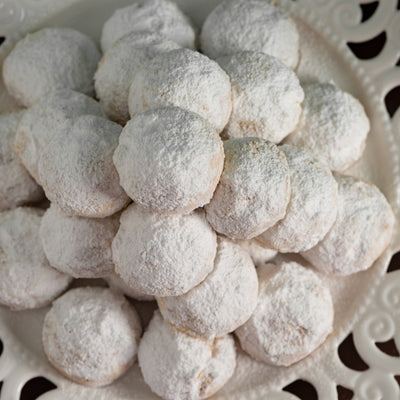
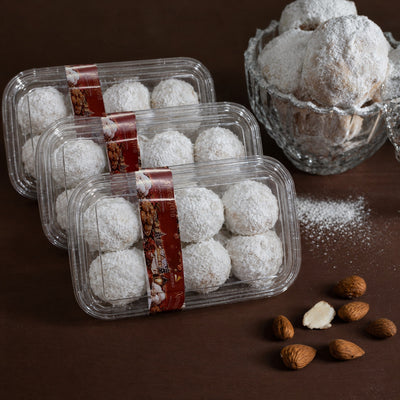
Kourabiedes are Greek Christmas cookies made with butter whipped for 15-20 minutes and toasted almonds, sprayed with rose water and covered in icing sugar.
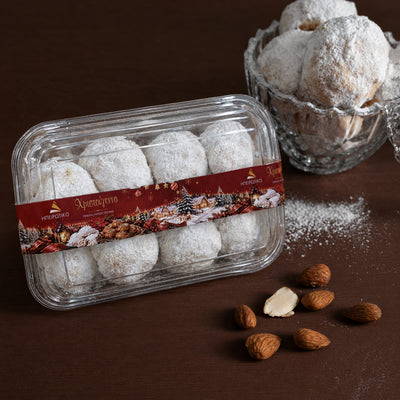
This recipe makes about 60 cookies; ready-made ones, handmade in Athens by the Ipirotiko bakery, are in our Artisanal Pastry collection.
Kourabiedes melt in the mouth at the first bite and leave icing sugar on your fingers, on the plate and usually on your clothes: in Greece, that is what Christmas tastes like at the coffee table. They are small Greek Christmas cookies made with butter whipped for a good 15 minutes, toasted almonds and a little orange blossom water, sprayed with rose water while still hot and covered in icing sugar.
The recipe below makes about 60 cookies of 30g, with 40 minutes of preparation and 40 minutes in the oven, almonds included. Keep a glass of water nearby: the first bite always comes with a cloud of sugar.

-

Preparation time
00:40
-

Cooking time
00:40
-

Cuisine
Greek
Ingredients
Makes about 60 cookies of 30g.
- 500g butter, at room temperature
- 220g icing sugar
- 1/2 teaspoon vanilla powder
- 1 teaspoon orange blossom water
- 30g bitter almond liqueur, cognac or rum
- 200-280g blanched almonds, coarsely chopped, unsalted and toasted
- 900g flour (all-purpose or soft wheat)
- 1 pinch of salt
To finish:
- 1 tablespoon rose water
- 300g icing sugar

What are kourabiedes?
Kourabiedes (kourabies in the singular) are light golden Greek cookies with almonds, covered with icing sugar. Like melomakarona, they are prepared for the Christmas holidays. In many parts of Greece they are also offered to guests right after a baptism or a wedding.
Their name comes from the Persian Qurabiye, a biscuit made from flour, butter and powdered sugar. In 1924, refugees from Karvali in Cappadocia, in Asia Minor, settled in the prefecture of Kavala and called their new home Nea Karvali. They brought the traditional kourabiedes recipe of Asia Minor with them, and today the most famous kourabiedes in Greece are still those of Nea Karvali.
Kourabies belongs to Christmas, although Greek customs make it the main festive treat of celebrations all year round. Kourabiedes are offered at weddings and baptisms as a symbol of luck. Their white colour is said to bring pure celebration and the wish for happiness, and they are made of thousands of grains of flour and sugar, as many as our dreams and hopes.
At home, most families bake kourabiedes in the last week before Christmas, so the tins are full for the holidays. Bakeries and pastry shops start much earlier: from mid-November, sometimes before, they smell of butter and toasted almonds, two of the four main ingredients of a kourabies.
The butter (from cow's or goat's milk) should release a soft aroma and leave a pleasant, balanced aftertaste. Kourabiedes must melt in your mouth. The almonds should be fresh and of excellent quality: toasting them on a baking tray adds flavour and crunch to the cookie.
The secret of good kourabiedes lies in the ingredients you use, and above all in the butter, which should be of exceptional quality. Here is how to make them yourself.

The recipe in easy steps
- Preheat the oven to 180°C (fan). Put parchment paper on a baking sheet and spread the almonds on it so that they are not stacked. Bake them for 10-15 minutes, until lightly browned. Let them cool completely.
- Beat the butter and icing sugar in a large bowl. Whip them at high speed for about 15-20 minutes, until the mixture is light and white.
- Stop the stand mixer, add the vanilla powder, orange blossom water and bitter almond liqueur, and mix again for a few seconds.
- Crush the almonds and add them to the flour with the salt.
- Gradually add the flour, almonds and salt to the butter mixture. Fold them in with a spatula, very gently, so that the mixture keeps its volume. Once the ingredients are combined, finish mixing with your hands. Do not over-knead, or the kourabiedes will become hard.
- On a baking sheet lined with baking paper, shape small ovals of about 30g (or use a cookie cutter). Press each one lightly in the centre with your finger, so they bake evenly.
- Bake at 180°C (fan) for 20-25 minutes.
- While they are still hot, spray them with rose water.
- Let the kourabiedes cool a little, then sprinkle them generously with icing sugar before serving. Whoever tries kourabiedes for the first time should take a small bite, because there is a lot of icing sugar. Always serve them with a glass of water.
- Arrange them on a pretty plate and enjoy!
Tips for kourabiedes
- Because they contain a lot of butter, they are very soft when they come out of the oven: do not overbake them, or they will turn hard like an ordinary biscuit.
- If you don't have a stand mixer, put all the ingredients in a bowl with 1 tablespoon of baking powder (only if mixing by hand) and beat them until the mixture is smooth.
- To store kourabiedes, cover them with plastic wrap at room temperature. You can keep them in the freezer for 3 months: defrost them at room temperature and add the icing sugar just before serving.
- You can decorate kourabiedes with cloves, which also give them a different flavour.
Ready-made kourabiedes, handmade in Athens
If you would rather not whip butter for 20 minutes, do what many Greek families do and buy them at the pastry shop. Ours are shaped by hand in Athens by the Ipirotiko bakery: short, crumbly cookies that melt rather than crunch, under a thick coat of icing sugar, to put out with coffee or take with you when you are invited.
- Kourabiedes 320g, one tray, handmade in Athens
- Kourabiedes 960g, three 320g trays
The rest of our Greek sweets are in the Artisanal Pastry collection. Delivered across Europe.
Kourabiedes: frequently asked questions
Why did my kourabiedes turn out hard?
Usually for one of two reasons: the dough was kneaded too long, or the cookies stayed in the oven too long. Fold the flour and almonds in gently and stop as soon as the dough comes together. Bake them at 180°C (fan) for 20-25 minutes: kourabiedes are very soft when they come out of the oven, so do not wait for them to feel firm before taking them out.
Can you freeze kourabiedes?
Yes, for up to 3 months. Let them thaw at room temperature and add the icing sugar just before serving, so it stays white and fresh. For a few days at room temperature, keep them covered with plastic wrap.
When do Greeks make kourabiedes?
At home, most families bake them in the last week before Christmas. Bakeries and pastry shops start selling them from mid-November, sometimes earlier. Kourabiedes are also offered at weddings and baptisms all year round, as a wish for luck.
Where can I buy kourabiedes ready-made?
Greek pastry shops sell them from mid-November. Greek Flavours has kourabiedes handmade in Athens by the Ipirotiko bakery, crumbly and under a thick coat of icing sugar, in a 320g tray or in a 960g pack of three trays. You will find them in our Artisanal Pastry collection.