Skip to content

In September, a Greek kitchen restocks in a predictable order. First, the fresh anchors that make a meal on their own, which means feta, pita, and yogurt. Then the dry backbone that carries the week, which means olive oil, olives, legumes, and honey. Aged cheese comes last, as the weather turns. That order is not a matter of taste. It follows how often each item is actually used, and how quickly the shelf empties once real cooking starts again.
This guide is the practical version of that sequence: what goes back first and why, how much a household of four gets through in a week, what a first week of cooking looks like without a meal plan, and what to know about ordering food that travels from Greece. Nothing here assumes you cook every night. It assumes you want the shelf to be right when you do.
Why the return happens in three waves
The summer table runs on assembly. Olives, a block of feta, tomatoes, bread, something from a jar. Very little of it needs a pan, which is exactly what makes it work in August. September breaks that pattern because the household reassembles and meals go back to being scheduled rather than improvised.
So the shelf has to be rebuilt, but not all at once. The first wave is the fresh anchors, which turn a weeknight into dinner without a recipe. The second is the dry backbone, which fills the other five days and keeps for months. The third is the aged and slow-cooked side, which becomes interesting only once the evenings cool down, usually from the second half of the month.
Buying in that order wastes less than buying everything at once, and it matches how the produce behaves. Fresh cheese and pita want to be eaten in the weeks after they arrive. A tin of olive oil does not care.
Wave one: the fresh anchors
These are the three items that separate a stocked kitchen from a kitchen you can actually cook in on a Tuesday.
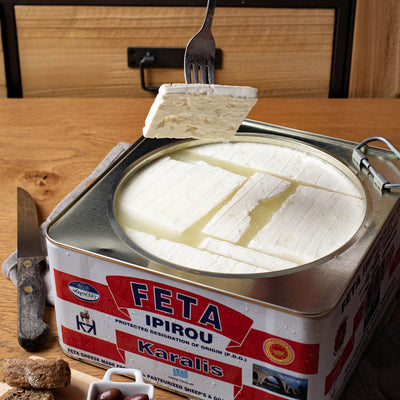
Feta PDO, the first thing back on the shelf
Feta is protected by a PDO: the name belongs only to cheese produced in defined regions of Greece from sheep's milk, with goat's milk permitted up to a limited share, and matured by the traditional method. Everything else sold in a similar white block is a feta-style cheese, and it behaves differently in the pan and on the plate.
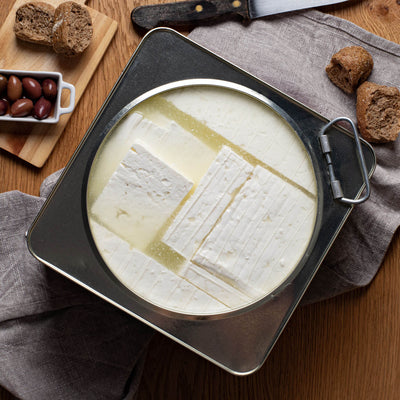
Inside the PDO there is real variation. Feta matured in wooden barrels, of the kind produced in the Peloponnese and in mountain Arcadia, develops a firmer body and a sharper flavour over about three months. Tin-matured feta from Epirus and from Lesvos is creamier and rounder, which makes it the easier everyday block for a family. Both are PDO, and they are not interchangeable. A whole sheep's milk cheese made through natural fermentation, feta has a place at breakfast with bread and honey, at lunch over legumes, and at dinner baked with vegetables. It is a main element of the meal, not only a garnish.
Format is the decision usually made carelessly. A 150g or 200g vacuum portion suits one or two people who eat feta twice a week. A 400g or 500g block in brine is the family format and keeps for weeks in its own liquid. Tins of 1kg and above make sense only if feta is a daily item in your house.
Browse the feta and cheese selection, or read the complete guide to Greek feta if you want to choose by region rather than by size.
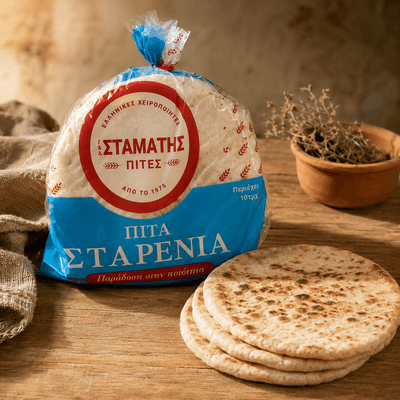
Pita, back to being everyday bread
In July, pita is a grill accessory. In September it goes back to what it is in Greece for most of the year, which is bread, and that shift changes which pita to buy.
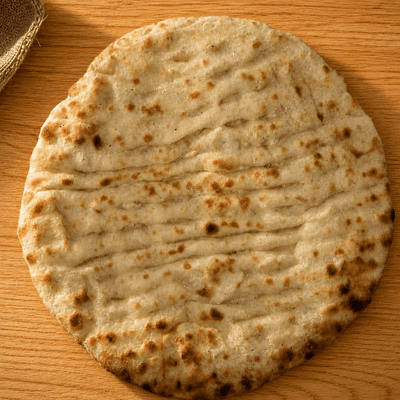
The everyday round is the 16cm or 18cm wheat pita, soft enough to fold and sturdy enough to hold a filling. Hand-torn pita from Athens producers, made for street-food use, comes in 18cm and 24cm formats with a more irregular, chewier structure, which is what you want when the pita is the plate rather than the side. Sourdough and fibre-enriched rounds hold up better under something wet; wholemeal has a denser bite, and mini pita at 11cm is closer to an aperitivo format than to bread.
One practical note decides how you order it. Pita is a fresh product but not a cold chain product: it travels by air rather than in temperature-controlled transport, so it arrives quickly and needs no refrigerated delivery slot. The freezer is a legitimate destination for the packs you will not finish within the week.
See the pita bread range, and if you want the serving logic rather than the shopping logic, the guide on how to serve Greek pita covers what goes with what.
Yogurt and kefir, the breakfast that restarts
Greek yogurt and kefir never leave the shelf; what changes in September is where they sit in the day. Through August, breakfast is whatever happens after the beach, and it rarely involves a spoon. From the first week back, breakfast returns to a fixed hour, for people who have to leave the house, and these two become the most useful things in the fridge again.
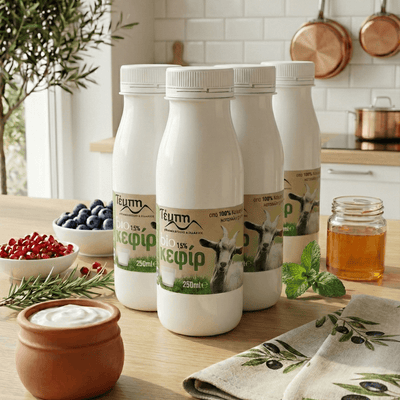
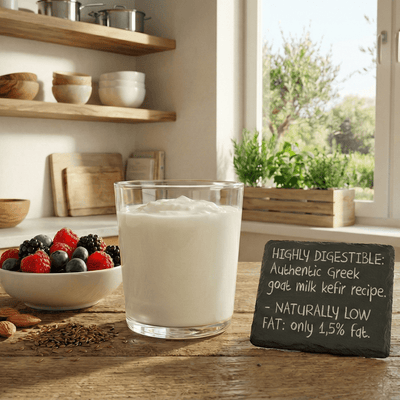
Sheep's and goat's milk yogurt is denser and more savoury than the strained industrial versions sold as Greek-style, which makes it a base rather than a dessert: honey and walnuts in the morning, the body of a tzatziki in the evening. Kefir is a fermented milk drink with live cultures, thinner and mildly sour, at home in a glass, a dressing, or a marinade rather than in a bowl.
Both travel in the cold chain, which is the reason they reach you in the condition they left in. Orders containing them are packed with temperature-controlled protection and dispatched Monday to Wednesday, so that no fresh box spends a weekend in transit. An order placed later in the week simply leaves on the following Monday, and nothing about the wait changes what arrives.
Wave two: the dry backbone
This is the half of the shelf that does not need planning once it is right, because it keeps. It is also where the cost per meal drops sharply.
Olive oil, the one that gets used every day
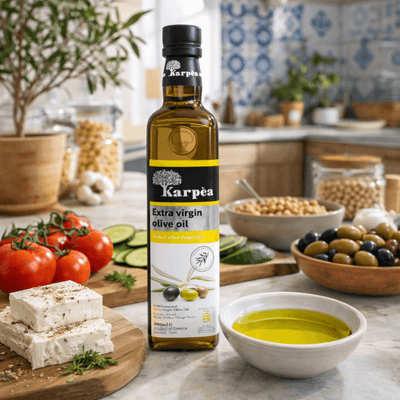
Extra virgin olive oil is the most used item on this list, which is why it is worth buying in a serious format rather than a small bottle. Two rules make the difference at home: buy a size you will finish within about a year of opening, since oil degrades through air and light rather than through time on the shelf, and keep it in the dark away from the hob, which is the most common way a good bottle is quietly ruined.
If you want to be able to tell a serious oil from a marketed one before you buy, the article on how to identify authentic Greek extra virgin oil covers the labels that mean something.
Olives, the snack that is also an ingredient
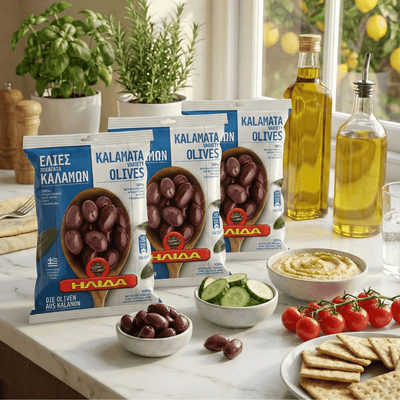
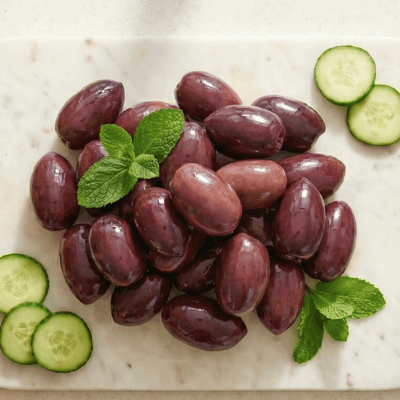
Olives are underbought because people think of them as an aperitivo and forget they are also a cooking ingredient. Kalamata olives, dark and almond-shaped, carry a deep, almost balsamic note that holds up in a baked dish. Green Halkidiki olives are larger, firmer, and milder, which makes them the better table olive. A jar of each covers both jobs. The guide to Greek olive varieties is the shortcut if you want to buy by use rather than by name, and the olive selection is where they live.
Legumes, the part of the return that most people skip
Legumes are the backbone of Greek home cooking from autumn onwards, and the category most non-Greek households leave out of the restock, usually because dried legumes mean planning and soaking.
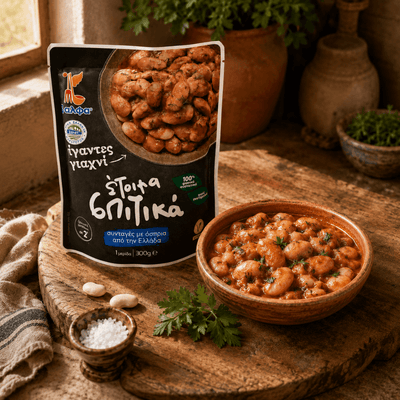
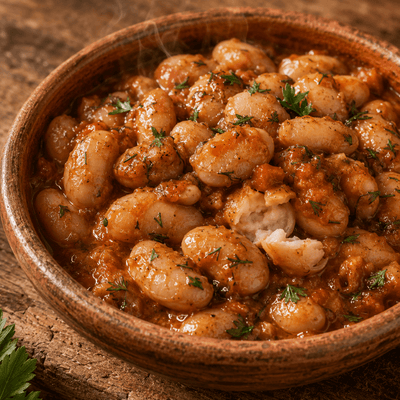
That objection has largely stopped being true. Ready formats cover the weeknight case honestly: giant beans in tomato in the yahni style, ready in about two minutes, and revithada, the slow-baked chickpea dish from Sifnos, in the same format. Steam-cooked black-eyed and red kidney beans come in 180g portions with nothing added, which makes them a base rather than a finished dish. The dried side stays worth keeping for weekends, when time is not the constraint and the result is better: gigantes with PGI status from Prespes and Kastoria, Farsala lentils, split fava from yellow peas, and skinless chickpeas for hummus and soups cover almost everything a Greek kitchen does with legumes.
Browse the legume range, ready and dried together.
Which format belongs to which night of the week is worked through in our guide to ready and dried Greek legumes.
Honey and the rest of the shelf
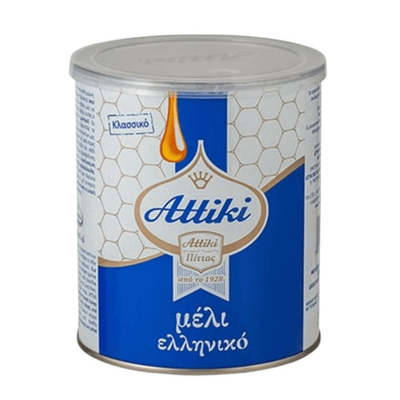
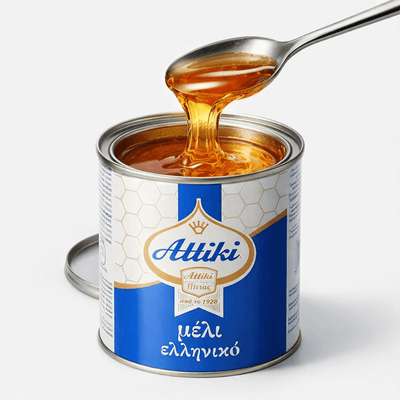
Greek honey closes breakfast and does a second job as a savoury element, most obviously with feta. Thyme honey is the assertive one, fir honey the mild and resinous one, and a jar lasts. Beyond it, the shelf fills with what turns a plain dinner into a table: tahini, preserved vegetables, dolmades, dried herbs. None of them is urgent, and all of them are what make the difference in week three, when the enthusiasm of the first restock has worn off.
See the full pantry selection.
How much to order for a first week
The most common mistake in a September restock is a wide basket in small sizes, which runs out in ten days and makes the next order urgent. Below is a realistic first order for a household of four cooking Mediterranean four or five nights a week.
| Item | First order, four people | Lasts about |
|---|---|---|
| Feta PDO | 400g to 500g in brine | 2 to 3 weeks |
| Pita bread | 2 packs of 10 rounds | 1 to 2 weeks, freezer for the rest |
| Greek yogurt | 1kg to 1.5kg | 1 week |
| Extra virgin olive oil | 1L to 3L, depending on how you cook | 2 to 6 months |
| Olives | 1 jar Kalamata, 1 jar green | 3 to 4 weeks |
| Ready legumes | 3 to 4 portions | the weeknights of one week |
| Dried legumes | 2 packs of 500g | 4 to 6 weekend dishes |
| Honey | 1 jar, 450g to 1kg | 2 to 3 months |
If the basket has to be smaller, cut the dried legumes and the second olive jar first. They are the items whose absence you will not feel in the first two weeks.
A first week of cooking, by effort
That shelf produces the week below without a meal plan and without a shopping trip in between. The point of the table is the left column: on a September Tuesday, the question is not what to cook; it is how much attention you have left.
| Effort | Dish | From the shelf | Time |
|---|---|---|---|
| None | Yogurt, honey, walnuts | Yogurt, honey | 2 minutes |
| None | Gigantes yahni with bread and feta | Ready legumes, feta, pita | 5 minutes |
| Low | Warm pita, olive oil, olives, feta | Pita, EVOO, olives, feta | 10 minutes |
| Low | Baked feta with tomatoes and oregano | Feta, EVOO, dried oregano | 25 minutes, mostly in the oven |
| Medium | Lentil soup, Greek style, with olive oil and vinegar | Farsala lentils, EVOO | 45 minutes |
| Weekend | Gigantes baked in tomato, from dried | Dried gigantes, EVOO | soaking, then 90 minutes |
Five of these six need nothing fresh from a supermarket beyond tomatoes and an onion. That is the actual test of a well-built shelf.
Ordering food that travels from Greece
A restock that arrives at the wrong time is not a restock. Three things are worth knowing before the first order of the season.
Preparation and transit are two separate times. Orders are prepared in two to four working days, and transit is added on top. When you are planning for a specific weekend, count both.
Cold chain products leave early in the week. Yogurt, kefir, and fresh cheese ship in temperature-controlled packaging and depart Monday to Wednesday, so they do not spend a weekend in transit. An order placed on Thursday for these items departs the following week.
Pita is fresh but not refrigerated. It travels by air and arrives quickly, without the timing constraints that apply to the cold chain.
Once the box is open, what goes into the fridge, what stays in the cupboard and how each product keeps is covered in our guide to storing Greek food on arrival.
Where to start if you are rebuilding the shelf from scratch
Take the order rather than the list. Start with feta, pita, and olive oil, the smallest combination that produces real meals, and add olives and a ready legume format in the same order, because they cover the two weeknights when nothing was planned. Everything else can wait for the second order, when you know what you actually reached for.
The authentic Greek pantry holds the dry side of that list, and the feta and cheese selection holds the fresh anchor. Everything is shipped from Greece and delivered across Europe.
Frequently asked questions about restocking a Greek kitchen in September
What are the essential Greek pantry items to buy first?
Feta PDO, fresh pita, and extra virgin olive oil are the three that produce meals on their own. Olives and a ready legume format follow immediately, because together they cover the weeknights when nothing was planned. Honey, tahini, dried legumes, and preserves belong to the second order. Buying in that sequence avoids a wide basket of small sizes that empties in ten days.
How much feta does a family of four need for a week?
A 400g to 500g block in brine covers a household of four that eats feta two or three times a week, and it keeps for several weeks as long as it stays submerged in its own liquid. One or two people are better served by 150g or 200g vacuum portions. Formats above 1kg make sense only when feta is a daily item.
What is feta PDO made from, and where does it fit in a meal?
Feta PDO is made from whole sheep's milk, with goat's milk permitted up to a limited share, and matured through natural fermentation. In a Greek meal it works as a main element rather than only as a garnish, and its nutritional values are shown on the label of each product. It is also a salted cheese, so it belongs on a balanced plate rather than eaten alone in quantity.
What is the difference between barrel-aged feta and feta in a tin?
Both are PDO, and the difference is the maturation vessel. Feta matured in wooden barrels, traditionally in the Peloponnese and in mountain Arcadia, develops a firmer texture and a sharper flavour over roughly three months. Feta matured in metal tins, characteristic of Epirus and Lesvos, is creamier and milder, which makes it the easier everyday choice for a family.
Are ready-to-eat Greek legumes as good as dried ones?
They serve different purposes. Ready formats such as gigantes in tomato or revithada from Sifnos are cooked dishes needing about two minutes of heating, and they exist for weeknights. Dried gigantes, lentils, and fava need soaking and long cooking, and give a better result when time is not the constraint. A working Greek shelf carries both.
How should I store Greek olive oil at home?
Away from light and away from heat. Olive oil degrades through contact with air and light rather than through the passage of time, so a bottle kept next to the hob deteriorates faster than one in a closed cupboard. Buy a format you will finish within about a year of opening, and decant from a large tin into a smaller bottle for daily use.
Does Greek pita bread need to be refrigerated in transit?
No. Pita is a fresh product but not a cold chain product: it travels by air rather than in temperature-controlled transport, so it arrives quickly and can be ordered without the timing constraints that apply to yogurt, kefir and fresh cheese. Packs that will not be eaten within the week freeze well.
When should I place an order to have everything for the weekend?
Count two separate times. Orders are prepared in two to four working days, and transit is added on top. Cold chain items such as yogurt, kefir, and fresh cheese depart Monday to Wednesday so they are not in transit over a weekend, which means a Thursday order for those items leaves the following week. Dry pantry goods and pita are not subject to that constraint.