Skip to content



Stamatis
Stamatis Hand-Torn Greek Wheat Pita — Athens Street-Food Standard (5 × 24 cm)
Stamatis Hand-Torn Greek Wheat Pita — Athens Street-Food Standard (5 × 24 cm)100 in stock
Couldn't load pickup availability


 ❄️ FRESH DELIVERY — Shipped from Greece, arrives fresh · These products travel by express air freight in insulated packaging to protect freshness from our warehouse to your door. · 🗓️ We ship Monday, Tuesday and Wednesday only — this protects your order over the weekend. · ⏱️ Delivery in 24–48 hours from dispatch · 📦 Order preparation: 2–4 working days · 🤝 Our promise: if your order arrives damaged or not as described, contact us — we will find the right solution. · 👉 How FRESH shipping works →
-
 Vegan
Vegan
Product Description
Product Description
The pita that every Athenian souvlaki is wrapped in — now delivered to your kitchen.
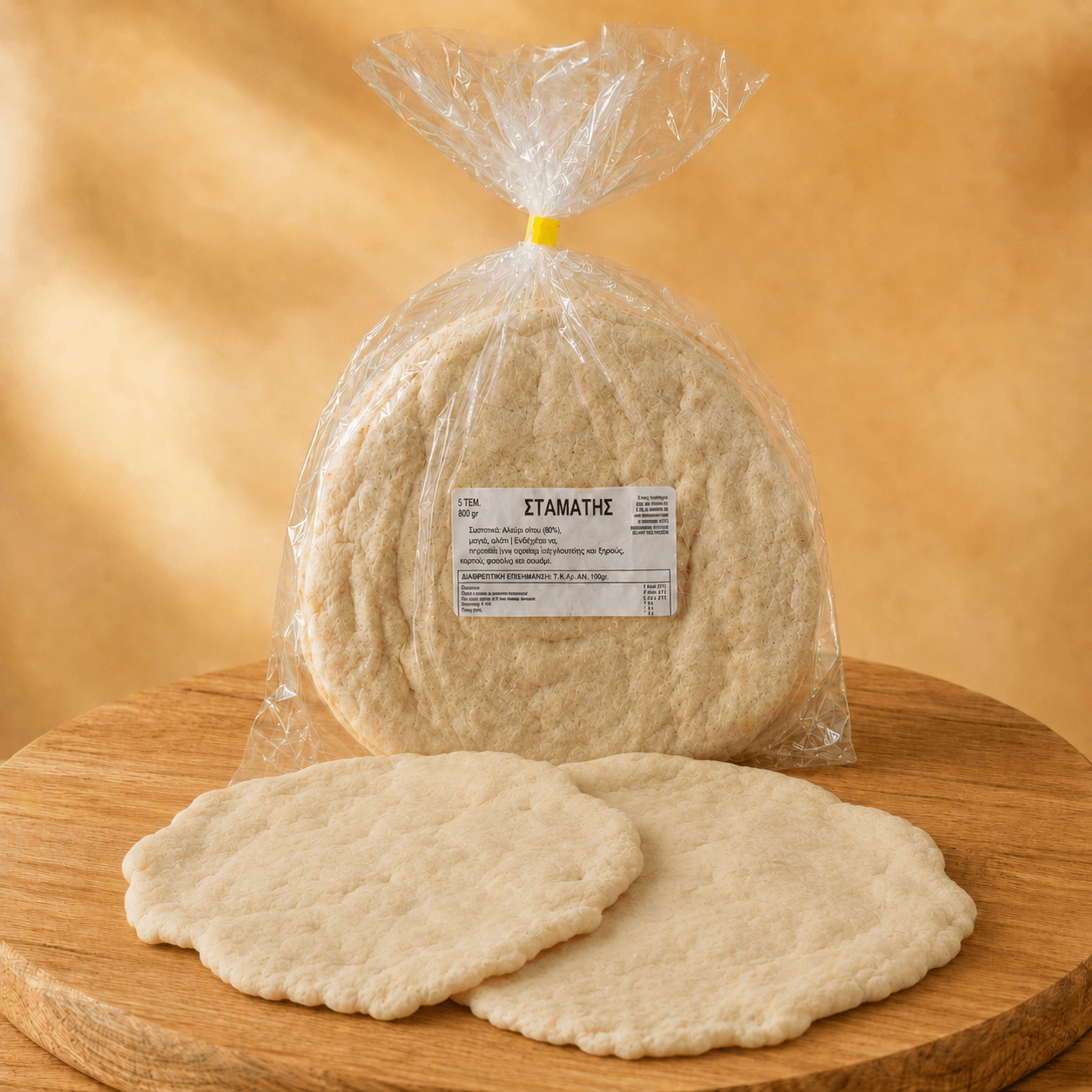
The Stamatis pita is the bread behind Athens street food. If you have eaten a souvlaki in the Greek capital — at a real souvlatzidiko, standing at the counter, with grease on your fingers — there is a good chance this is what you ate. Stamatis is the reference supplier for Athens' professional kitchen, and this format, baked with simple wheat flour and no preservatives, is the same one used there daily. Each round measures 24 cm, making these the largest hand-made pita rounds currently available for home delivery in Europe.
Unlike machine-pressed pita, each round is stretched entirely by hand from first to last. The dough is never passed through a roller. This gives each piece an irregular shape and a slightly uneven surface — which is exactly what makes it behave correctly at high heat: it blisters and puffs in the right places, stays soft at the fold, and holds fillings without tearing. Warm it on a dry pan, a grill, or directly on the barbecue grate for 30–40 seconds per side.
Fresh on arrival — but not for long. Here is what to do the day the box arrives.
These pitas leave Greece fresh and unrefrigerated. They arrive within their shelf life — typically 3 days at room temperature — which means your first decision on delivery day is whether to refrigerate or freeze. Both work well. The key rule is simple: do not thaw before heating. Place frozen pitas directly onto a hot pan or grill straight from the freezer. Thawing first makes them wet and weakens the fold.
- At room temperature: 3 days from production
- Refrigerated (0–4°C): up to 6 days
- Frozen (−18°C): up to 12 months — freeze on arrival if you are not using all 5 rounds immediately
- Heating from frozen: straight from the freezer to a dry pan or grill — no thawing, no waiting
Fully hand-made versus semi-manual: what the difference actually means.
Most artisan-style pita on the market — including good ones — goes through a machine rolling step before the final hand-shaping. This produces a more uniform base that is then finished by hand. The Stamatis pita skips the machine entirely: the dough is torn and stretched by hand from the start, which produces a different internal structure. The gluten network develops unevenly, the thickness varies across the round, and the surface behaves differently under heat. The result is a pita with a more irregular texture, more variation in chew, and a fold that holds under the weight of a proper souvlaki filling. It is a more labour-intensive process, and that is reflected in the price point.
- No machine rolling at any stage: the dough is hand-torn and hand-stretched from the first step
- Visible irregularity is the confirmation: no two rounds are identical — that is correct
- Vegan and preservative-free: no dairy, no eggs, no artificial shelf-extension
How to use it:
- Filled with grilled meat, tzatziki, and red onion — the classic Athens souvlaki format
- Warmed and served alongside meze, dips, and olives as a sharing table bread
- Used as a base for open flatbreads with roasted vegetables, feta, or tahini spreads
- Eaten warm, straight from the pan, with nothing, because a good pita earns that
Five rounds per pack. Freeze what you do not use the day they arrive.
Nutritional Components
Nutritional Components
Simple bread, honest numbers: what the Stamatis pita actually contains.
At 242 kcal and 7.9g of protein per 100g, with only 1g of fat, it functions as a genuinely lean bread — a neutral carrier that does not compete with the filling and does not weigh the meal down.
What the label tells you:
- No preservatives: shelf life is controlled through temperature management: refrigerate or freeze on arrival
- Vegan-friendly: no dairy, no eggs, no animal-derived ingredients of any kind
- Low fat: 1g per 100g — one of the leanest bread formats in this category
- Protein contribution: 7.9g per 100g — relevant when paired with protein-rich fillings for a complete meal
- No added sugars: the 2.5g of sugars per 100g are naturally occurring from fermentation, not added
Nutritional values per 100g:
- Energy: 1020 kJ / 242 kcal
- Fat: 1g — of which saturates: 0.3g
- Carbohydrates: 51g — of which sugars: 2.5g
- Protein: 7.9g
- Salt: 1.1g
Ingredients: wheat flour 58%, water, salt, yeast, wheat malt, ascorbic acid, L-cysteine, enzymes, stabilizer, emulsifier.
Allergens: contains gluten. May contain traces of soya, mustard, celery, lupine, and sesame.
Produced by Stamatis in Athens, Greece. No artificial preservatives. Suitable for vegan diets.
Useful Information
Useful Information
Storage guide: fresh bread from Athens — manage it like a professional.
These pitas arrive fresh, not frozen. The storage window at room temperature is short by design — three days — because there are no preservatives to extend it. The correct habit is simple: decide on the delivery day how many rounds you will use over the next three days, and freeze the rest immediately. Once frozen correctly, they last twelve months and behave identically to fresh when heated directly from the freezer.
How to store it correctly:
- Room temperature: keep in the original sealed packaging, away from direct heat or sunlight — consume within 3 days
- Refrigerator (0–4°C): wrap tightly or reseal the original pack to prevent the surface from drying — good for up to 6 days
- Freezer (−18°C): freeze individual rounds separated by parchment paper if you want to remove them one at a time — up to 12 months
Freshness timeline:
- Room temperature, unopened: up to 3 days from production
- Refrigerated: up to 6 days
- Frozen at −18°C: up to 12 months
How to heat from frozen — the one rule that matters:
Do not thaw. Place the frozen pita directly onto a preheated dry pan, grill, or barbecue grate. Heat for 30–60 seconds per side, depending on surface temperature. The pita softens, puffs slightly in places, and is ready to fill. Thawing first makes the dough wet and weakens the structure at the fold — the mistake most people make once and do not repeat.
Product details:
- Format: 5 hand-torn wheat pita rounds, fresh (not frozen at dispatch)
- Size: 24 cm diameter per round
- Origin: Athens, Greece
- Producer: Stamatis
- Allergens: contains gluten — may contain traces of soya, mustard, celery, lupine, sesame
- Suitable for: vegan diets
Why Stamatis — and why this format.
Stamatis is the supplier behind Athens' souvlatzidika. The 24 cm format is a professional kitchen size — larger than most retail pita, sized for a proper wrap with generous filling. The fully hand-made process means no two rounds are identical: thickness varies, the surface is irregular, and that is exactly what produces the correct blistering and fold behaviour at high heat. This is the pita that Athens professionals use. It is now available for home delivery across Europe.
Share