

Amvrosia
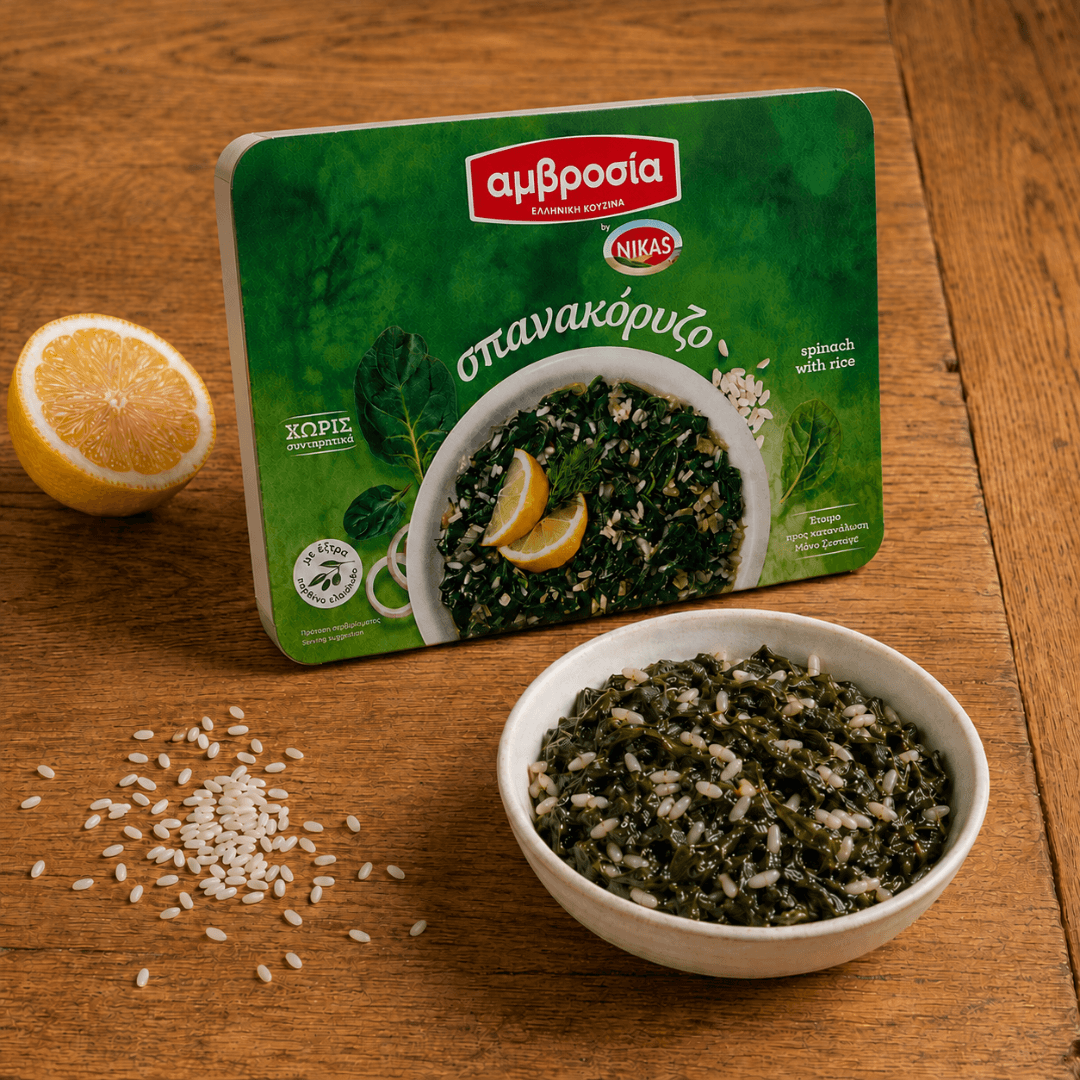
Greek Spanakorizo Spinach Rice - Fresh, Never Frozen (350g)
Greek Spanakorizo Spinach Rice - Fresh, Never Frozen (350g)100 in stock
Couldn't load pickup availability


 ❄️ FRESH DELIVERY — Shipped from Greece, arrives fresh · These products travel by express air freight in insulated packaging to protect freshness from our warehouse to your door. · 🗓️ We ship Monday, Tuesday and Wednesday only — this protects your order over the weekend. · ⏱️ Delivery in 24–48 hours from dispatch · 📦 Order preparation: 2–4 working days · 🤝 Our promise: if your order arrives damaged or not as described, contact us — we will find the right solution. · 👉 How FRESH shipping works →
-
 Vegan
Vegan
Product Description
Product Description
Three-quarters of this tray is spinach, cooked in olive oil the way a Greek household makes it.
Spanakorizo is spinach and rice cooked together in olive oil, and the proportion is the whole point: 75% spinach to 12% boiled rice, with onion, dill, and concentrated lemon juice. It belongs to the family of dishes Greeks call ladera, cooked in olive oil rather than seasoned with it at the end, and the 5% extra virgin olive oil here is the cooking medium that carries the lemon and the dill into the leaf. Amvrosia makes it in Sindos, outside Thessaloniki, and chills the tray rather than freezing it. One sealed 350g tray, never through a freezer.
Expect a vegetable dish, not a rice dish. The spinach cooks down dark and soft, the rice is boiled and scattered through it rather than binding it, and the finish is bright rather than creamy, because the lemon is in the recipe and not just on the side. It is seasoned plainly with onion and dill, and it is the lightest tray in this range at 322 kcal for the whole thing. Add a squeeze of fresh lemon at the table. That is how it is eaten in Greece, and it lifts the whole plate.
It is also the only dish in this range you do not have to heat. The tray is ready to eat, and the label asks only for warming, and spanakorizo is one of the few Greek dishes that is genuinely good cold, which is why it turns up at room temperature on Greek tables as often as hot. The recipe is entirely plant-based, with no meat, no dairy, and no egg, and it carries 7g of fibre and 2,91g of salt in a full tray, the second-lowest salt figure of any tray we sell.
No preservatives, and chilled rather than frozen: how that works
Fresh food ordered online raises the same question every time, which is how it keeps without a freezer or preservatives. The answer here is the packaging. The tray is sealed in a protective atmosphere, and that is what keeps the dish without anything being added to it.
- No preservatives in the recipe. The list printed on the tray is the whole story.
- Keep refrigerated below +7°C, and once opened, eat within 24 hours.
- Never frozen at any point, which is why the spinach keeps its texture instead of collapsing into water. The use-by date is printed on the tray.
How to use it
- Oven, 180°C for 13 to 15 minutes once preheated. Pierce the film in two spots first, and remove it before serving.
- Microwave, 3 to 4 minutes at 800W, same piercing step. Keep the tray clear of the oven element and the grill.
- Cold or at room temperature, straight from the fridge, with lemon and good bread. One of the few dishes that does not need the heat.
- With a piece of feta alongside, which is the Greek table's own answer to a plate that carries no protein of its own.
- As a light main on its own, or as the vegetable course next to grilled fish.
Nutritional Components
Nutritional Components
Three-quarters spinach, an eighth rice: what is actually in this tray
Spanakorizo is built from the leaf outwards. 75% spinach, then 12% boiled rice, onion, 5% extra virgin olive oil, dill, and concentrated lemon juice. There is no meat, no milk, and no egg anywhere in the recipe. The rice is there to carry the dish, not to fill it, which is why this is the lightest tray in this range at 322 kcal and why it is eaten as a vegetable dish rather than a plate of rice.
What the numbers mean in practice
- 322 kcal in a full tray: 92 kcal per 100g, the lowest energy per tray of anything in this range, and it comes from the spinach being three-quarters of the recipe.
- 7,0g of fibre per tray: 2,0g per 100g, from the spinach rather than from anything added.
- 2,91g of salt in a full tray: 0,83g per 100g, the second-lowest figure of the trays we sell. In a category where salt is the standard objection, this one holds up.
- Saturated fat at 0,9g per 100g, 8,8% of the energy in the dish. Almost all of the fat here is the olive oil and the sunflower oil.
- 9,5g of protein per tray: this is a vegetable and rice dish, and it is not where the protein on your plate should come from. A piece of feta or a bowl of yogurt alongside covers it.
- 5% extra virgin olive oil: second only to our gemista, and the reason this dish is classified as a ladero, cooked in oil rather than dressed with it.
- No preservatives: the tray holds because it is sealed in a protective atmosphere, not because anything was added to the recipe.
Nutritional values per 100g
- Energy: 382 kJ / 92 kcal
- Fat: 6,5g — of which saturates: 0,9g
- Carbohydrates: 4,7g — of which sugars: 1,1g
- Fibre: 2,0g
- Protein: 2,7g
- Salt: 0,83g
Per 350g tray: 1.337 kJ / 322 kcal, 22,8g fat, 3,2g saturates, 16,5g carbohydrates, 3,9g sugars, 7,0g fibre, 9,5g protein, 2,91g salt.
Ingredients
75% spinach, 12% boiled rice (water, rice), onion, 5% extra virgin olive oil, sunflower oil, dill, cooking salt, concentrated lemon juice, spices.
Allergens
No allergenic ingredients in the recipe. May contain traces of milk, wheat, sesame seeds, mustard, egg, celery, soybeans, fish, shrimps and crabs.
Produced and packed by Amvrosia SA, Sindos Industrial Zone NB6, Thessaloniki. All figures are taken from the printed label on the tray, which prevails over any other source.
Useful Information
Useful Information
Storage guide: below +7°C, and what the sealed tray does
This is a fresh, chilled dish, not an ambient or frozen one, and everything about how it's kept follows from that. It travels cold, it lives in the fridge, and the sealed film is what protects it until you open it.
How to store it correctly
- Keep refrigerated below +7°C: put it in the fridge as soon as it arrives, in the coldest part rather than the door.
- Do not freeze it: spinach that has been frozen and thawed gives up its water, and the dish turns loose. This is exactly what a chilled tray avoids.
- Leave the film sealed: the protective atmosphere inside the tray is doing the preservation work, and once the seal is broken, that protection ends.
Freshness timeline
- Unopened, refrigerated: keeps until the use-by date printed on the tray. Check that date when the parcel arrives.
- Opened: eat within 24 hours, kept refrigerated.
- Heated: eat straight away. Do not reheat a second time.
Suggested preparation
- Remove the outer cardboard sleeve.
- Pierce the sealing film in two spots with a fork.
- Oven: 180°C in a preheated oven for 13 to 15 minutes. Temperature and time vary with the oven.
- Microwave: 3 to 4 minutes at 800W.
- Remove the film and serve. The tray must not come into contact with the oven element or the grill.
- Or serve it cold. The tray is ready to eat, and this dish is one of the few that loses nothing at room temperature.
Product details
- Format: single sealed tray, ready to eat
- Net weight: 350g
- Origin: made and packed in Greece, Sindos Industrial Zone, Thessaloniki
- Producer: Amvrosia SA
- Diet: entirely plant-based, no meat, no dairy, no eggs in the recipe
- Storage: refrigerated, below +7°C, never frozen
- Allergens: no allergenic ingredients, traces possible
Why lemon belongs on this plate
Spanakorizo already carries lemon: concentrated lemon juice is in the recipe, which is what keeps a dish of cooked spinach from turning flat. Adding a fresh squeeze at the table is not a correction; it is the finish. Greek households do it as a matter of course, and it is the one instruction worth following on a dish this plain. The oil cooks it; the lemon finishes it.
Share