Yes, on the terms that matter. Feta PDO is a genuine protein source, made from sheep's and goat's milk with nothing added but salt, lactic cultures, and rennet, and it contains almost no carbohydrates and virtually no sugar. It is also a salty cheese, saltier than most, which is the part most articles leave out. So the useful question is not whether feta is healthy, but how much of it belongs in a week and which feta is worth the space in your fridge.
This guide reads the labels of the fetas we actually ship from Greece, explains what the PDO rule changes about what is inside the block, and sets out portions and weekly patterns that hold up in a real kitchen rather than on a nutrition chart.
What PDO guarantees, and why it changes the nutrition
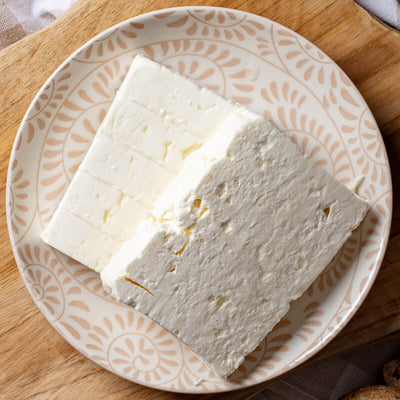
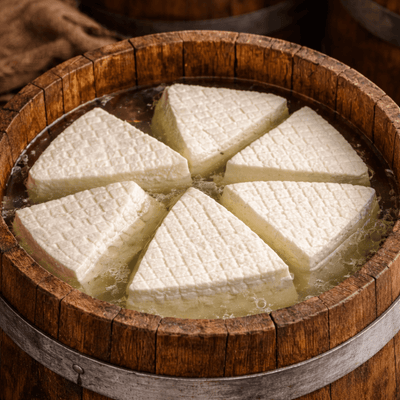
Feta has been a protected name in the European Union since 2002. It can only be made in defined regions of Greece, from sheep's milk, with goat's milk allowed up to a maximum of 30 per cent. It is matured and kept in brine, not in vacuum plastic alone, and the whole process is what produces the firm, crumbly, faintly grainy texture that industrial imitations approximate with acid and stabilisers.
This is not a label detail. Sheep's milk is denser than cow's milk in fat, protein and calcium, so a cheese made from it starts from a different nutritional base than a "feta-style" or "salad cheese" block made from cow's milk. When a supermarket product is called salad cheese rather than feta, the name itself is telling you that it did not qualify.
The second consequence is fermentation. PDO feta matures with live lactic cultures over weeks or months, and that ageing is why traditional feta is naturally low in lactose, a point our producers state on their own packaging.
What the label actually says
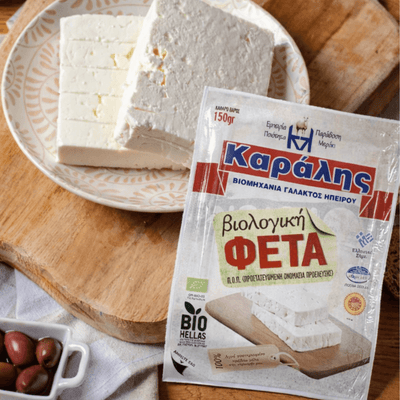
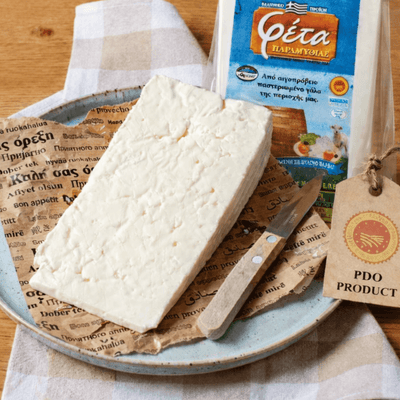
Below are the declared values from three of the PDO fetas we ship from Greece: an organic sheep's milk feta from Epirus, a family tin of Epirus feta kept in brine, and an oak barrel-aged feta. All three are the same legally protected cheese, and the differences between them are precisely what a nutrition label is for.
| Per 100 g | Organic Epirus | Epirus tin in brine | Barrel-aged |
|---|---|---|---|
| Energy | 282 kcal | 271 kcal | 303 kcal |
| Protein | 15.9 g | 17.5 g | 18 g |
| Fat | 23.5 g | 21.2 g | 26 g |
| of which saturates | 17.1 g | 15.0 g | 19 g |
| Carbohydrate | 1.7 g | 2.4 g | 2.5 g |
| of which sugars | 0.3 g | 0.1 g | 0 g |
| Salt | 1.8 g | 2.1 g | 1.2 g |
Three things stand out. The protein is real and complete, sitting between 16 and 18 g per 100 g across the range, which is why feta behaves like a protein in a meal, not a garnish. The carbohydrate is negligible, and the sugars are close to zero, which is unusual among everyday fridge staples. And the salt is the figure worth reading before you buy rather than after: a 50 g serving carries between 0.6 and 1.05 g of salt depending on which feta is in the fridge, so the choice of block matters more than the choice of day.
The barrel-aged block is the surprise in that table. It is the strongest in flavour and the lowest in salt of the three, because months in wood concentrate the taste through ageing rather than through brine.
Where feta sits in the Mediterranean diet
UNESCO inscribed the Mediterranean diet as intangible cultural heritage in 2013, and it has held its position at or near the top of global diet rankings for years on the strength of decades of research. What is often lost in the translation into a food pyramid is that this diet was never dairy-free. Cheese and yogurt appear in it daily, in modest quantities, as the thing that makes a plate of vegetables and pulses into a meal someone actually wants to eat twice a week.
That is the honest role of feta. A bowl of lentils with olive oil is nutritionally excellent and, for most people, is not eaten often enough to matter. The same bowl with 30 g of feta crumbled over it becomes a dinner rather than a resolution. Judged that way, feta earns its place not despite the salt and the fat but because they are what carries the rest of the plate.
How much feta, and how often
Portion, not frequency, is the variable worth controlling. Feta works most days of the week if the quantity stays where the flavour is already sufficient, which is lower than most people assume.
| Use | Portion | What it does |
|---|---|---|
| Crumbled over salad or roasted vegetables | 30 g | Adds around 5 g of protein and replaces added salt in the dressing |
| Baked in the oven with tomato, peppers and oregano | 50 g | Becomes the protein of the dish, so no second one is needed |
| Breakfast, with tomato, olive oil and bread | 30 g | A savoury alternative to a sweet start, with almost no sugar |
| On a meze board with olives and pita | 40 g | A shared course rather than a snack eaten standing up |
One practical rule closes the salt question. When feta is on the plate, salt nothing else. The cheese carries the seasoning of the whole dish, and a Greek kitchen has treated it that way for far longer than nutrition labels have existed.
Choosing a feta that earns the space
All PDO feta meets the same standard, but the formats behave differently in a weekly routine, and the choice is really about how you will eat it.
For everyday use
A block that opens fresh is the one that gets used rather than saved. The Organic PDO Feta from Karalis, made with organic sheep's milk from Epirus and vacuum sealed in single 150 g slices, is the right answer for a one- or two-person household, because each portion opens at its best instead of drying at the edges in a pack that was opened three days ago. Where feta is on the table several times a week, the Epirus tin in brine holds 3.5 kg in pre-cut blocks and keeps for months in its own liquid, which is how Greek households have bought it for generations and the reason a tin costs considerably less per kilo than a slice.
For flavour, and for the table
Barrel-aged feta is a different cheese in everything but name. The Barrel-Aged Feta PDO "Epirus Heritage" from Paramythias matures in oak barrels, which concentrates the flavour and gives the firmer, more mineral character that industrial feta-style products cannot reproduce. It belongs on a meze board or baked whole, not crumbled into a salad where the work of three months of ageing is lost.
See the full feta PDO range, from single 150 g portions to whole barrel-aged wheels.
Keeping it right after it arrives
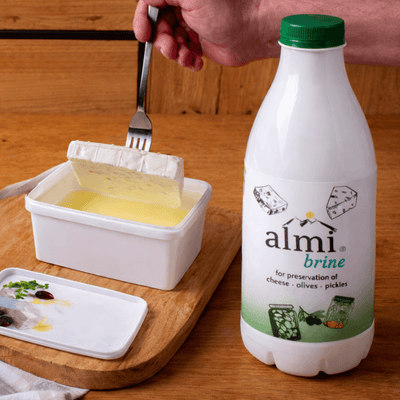
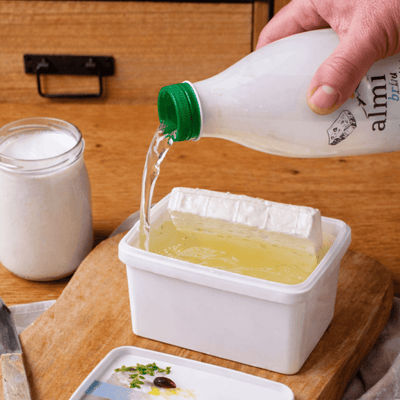
Feta is a living cheese, and it keeps in liquid, not in air. Once the pack is open, the block should stay covered in its own brine in a sealed container in the fridge, and it will hold its texture for weeks rather than days. If there is not enough brine left in the pack, our Almi Greek brine solution is made for exactly this and saves the block from drying out at the edges, which is the single most common way a good feta is wasted at home.
Feta is one part of the wider return to a Mediterranean routine that autumn makes easy, alongside pulses, olive oil, yogurt and the everyday breads that carry them. Our guide to the September return shelf covers how those staples fit back together after the summer, and the Autumn Reset selection gathers the products that carry the routine through the season.
Frequently asked questions about feta and health
Is feta cheese healthy?
Feta PDO is a nutritionally serious cheese: between 16 and 18 g of complete protein per 100 g, almost no carbohydrate, virtually no sugar, and calcium from sheep's and goat's milk. It is also salty, between 1.2 and 2.1 g of salt per 100 g depending on the cheese, and high in saturated fat, so it belongs in a daily routine in a portion of roughly 30 to 50 g rather than in an unmeasured quantity. Eaten that way, with vegetables, pulses and olive oil, it fits the Mediterranean pattern precisely.
Is feta a good source of protein?
Yes. At 16 to 18 g per 100 g, feta carries more protein than most fresh cheeses, and it is a complete protein containing all essential amino acids. A 50 g serving baked over vegetables provides around 8 to 9 g, enough for the dish to work as a meal without a second protein. This is why feta is treated as an ingredient rather than a topping in Greek home cooking.
Is feta too salty to eat regularly?
Feta is salty by design, because brine is how it is preserved, but the range is wider than most people expect. Across the PDO fetas we ship, a 50 g portion carries between 0.6 and 1.05 g of salt, and the barrel-aged blocks are often the least salty of all despite being the strongest in flavour. The practical answer is to read the salt figure before buying, to stop salting the rest of the dish when feta is in it, and to rinse the block briefly under cold water before serving if a particular batch tastes too sharp.
Is feta lower in lactose than other cheeses?
Traditional PDO feta is naturally low in lactose, because the long fermentation and ageing in brine consume most of the milk sugar, and our producers state this on their packaging. That is a general characteristic of the cheese and not a medical assurance: anyone managing a specific dietary need should read the individual product label and take their own advice.
What is the difference between feta PDO and feta-style cheese?
Only cheese made in defined regions of Greece from sheep's milk, with up to 30 per cent goat's milk, may legally be called feta in the European Union. Products labelled "feta-style", "salad cheese" or "white cheese" are usually made from cow's milk and produced industrially, and they differ in texture, flavour and nutritional profile. The name on the pack is the fastest way to tell them apart.